Why Slip Ratings Matter for Safety and Compliance
Slip resistance is one of the few surface properties that directly affects safety, liability, and operational risk. Almost every commercial, public, and industrial building in Australia must prove that pedestrian surfaces meet acceptable slip resistance criteria—especially in areas exposed to water, contaminants, or foot traffic.
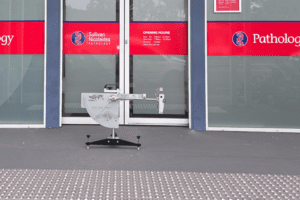
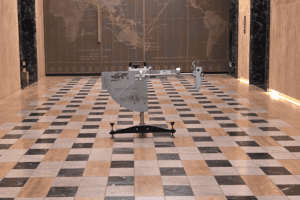
The AS 4586:2013 classification system exists to remove guesswork. It tells builders, architects, facility managers, and certifiers exactly how a new surface performs under standard wet conditions. These ratings are not subjective, decorative, or aesthetic. They are technical performance values measured using a calibrated device—the Wessex Portable Skid Resistance Tester (pendulum)—and represent real friction results.
A correct P-rating reduces falls, supports WHS due diligence, satisfies NCC requirements (referenced through HB 198:2014), and helps avoid costly replacements after installation.
How the Wet Pendulum Test Works (AS 4586:2013 Appendix A)
The wet pendulum test simulates the heel strike of a person walking across a wet surface. The equipment used is a Wessex Portable Skid Resistance Tester, the exact instrument referenced in the Standard.
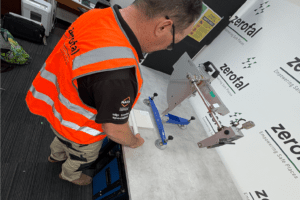
The test process involves five controlled steps:
- Prepare the rubber slider
Two slider rubbers may be used:
- Slider 96 (Four S rubber): for shoe pedestrian use, the most common
- Slider 55 (TRL rubber): for barefoot and aquatic environments
Rubbers are prepared using P400 abrasive paper and lapping film to ensure consistency.
- Wet the surface
The test area is flooded with a controlled volume of water.
- Swing the pendulum
The instrument’s arm swings forward. The rubber slider makes contact with the surface.
- Measure friction
The friction between rubber and surface slows the pendulum. The reading is a British Pendulum Number (BPN).
- Classify the result
Five consistent swings are averaged. That value maps to a P-rating.
Understanding the P-Classifications (P0–P5)
AS 4586:2013 Classification | BPN Range (Slider 96) |
P5 | > 54 |
P4 | 45–54 |
P3 | 35–44 |
P2 | 25–34 |
P1 | 12–24 |
P0 | < 12 |
This classification system is what designers and compliance teams must use when confirming suitability of new surfaces.
P4 vs P5 — The Real Differences
P4 is high slip resistance suitable for:
- Shopping centre entries
- Internal lobbies exposed to tracked moisture
- External pavements under awnings
- Healthcare corridors with intermittent water
- Retail fresh food areas
P5 is very high slip resistance required for:
- Commercial kitchens
- Food preparation zones
- External ramps (depending on slope)
- Loading docks
- Communal wet areas
- Aquatic environments (when using Slider 55)
When P5 is not appropriate
More friction is not always better:
- P5 can trap contaminants
- P5 surfaces can be harder to clean
- P5 may create visual wear faster
- P5 can feel coarse or overly rough
- P5 is unnecessary where the NCC does not require it
The goal is fit-for-purpose, not maximising friction.
What Affects Slip Ratings?
Even two tiles from the same product line can perform differently. Several variables influence results:
1. Microtexture
Traction comes from microscopic peaks on the surface. Polishing, glazing, or wear can alter them.
2. Colour pigmentation
Darker glazes cure differently, changing surface hardness. A light matt may be P4 while a dark polished version falls to P2.
3. Surface coatings and sealants
In general, most sealers lower slip resistance. Anti-slip coatings increase it. Burnishing reduces it.
4. Manufacturing variance
Batch differences in firing temperature, clay composition, or glazing produce real differences in BPN results.
5. Cleaning products and residue
Detergent film is one of the most common causes of reduced slip resistance.
6. Wear and contamination
Foot traffic, trolleys, oils, and grit gradually lower P-ratings.
7. Other factors
- Quality controls
- Human error
- Humidity
- Curing times
NCC Expectations (Referenced Through HB 198:2014)
AS 4586:2013 is a testing standard—not an interpretation standard. The NCC uses HB 198:2014 to define minimum recommended P-ratings for different building applications.
Some examples include:
- Hotel bathrooms and ensuites: P2
- Toilet facilities: P3
- External ramps: P4 or P5 depending on slope
- Undercover car parks: P3
- Commercial kitchens: P5
- Retail food courts: P3
Understanding these requirements ensures designs are compliant before installation—not after an expensive error.
Reviewing Slip Test Reports Correctly
A compliant test report should include:
- Test location
- Sample description
- Test method (Pendulum / Dry Friction)
- Slider type and conditioning
- Environmental conditions
- Raw swing values
- Mean BPN
- Final P-rating classification
- Photos of the specimen
- Calibration references
Missing data is a red flag.
When to Test Surfaces (AS 4586 vs AS 4663)
AS 4586:2013 — New Surfaces (Lab Testing)
Use this before installation to ensure the product itself meets the required rating.
AS 4663:2013 — Existing Surfaces (In-Situ Testing)
Use this after installation or over time to verify real-world performance.
Both test methods use the same pendulum equipment but the results are interpreted differently.
Summary: Choosing the Right Rating
Use P5 when:
- contamination is likely
- slope > 4 degrees
- water is present regularly
- food handling occurs
Use P4 when:
- you need strong wet resistance but not extreme texture
- NCC calls for P4 for the area type
- aesthetics or comfort matter
Use P3–P2 in lower-risk internal spaces – only where moisture is controlled and NCC classification allows.