Why Entry Zones Consistently Present Risk
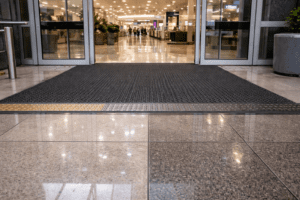
Retail entries concentrate three variables simultaneously:
- High pedestrian traffic
- Moisture transfer from external surfaces
- Change in surface material or finish
Customers move from rough external pavement to smoother internal tile. Shoes carry moisture and fine debris. Surface contamination increases.
Even high-performing materials can underperform in this transition.
This is not a design flaw. It is a friction reality.
The Gradient Variable Most Sites Overlook
Many retail entries include subtle slopes for drainage.
Where gradients exceed 1:5, slope correction must be applied during testing under AS 4663:2013.
Failure to account for slope can materially alter classification results.
In a claim environment, incorrect slope interpretation may weaken documentation.
Entry zones require proper measurement — not assumption.
What a Single Classification Shift Means
Consider an entry that previously tested at P4.
Six to twelve months of traffic polishing reduces surface microtexture. Seasonal contamination increases. Reassessment now classifies the area at P3.
No visual change is apparent.
However:
- The surface may no longer meet its originally specified requirement
- Monitoring frequency may be questioned
- Cleaning regimes may be scrutinised
- Documentation timing may influence insurer response
Retail environments are high-visibility claim environments. Monitoring entry performance annually demonstrates active oversight.
Transitional Areas and the HB 198 Guidance
Retail entry thresholds are also considered transitional areas under the guidance provided in HB 198:2014 – Guide to the specification and testing of slip resistance of pedestrian surfaces.
The handbook recognises that areas where pedestrians move between environments — such as external pavement to internal flooring — can introduce changing contamination and moisture conditions.
In these locations, surface performance may be considered “as managed by” additional controls such as:
- entry matting systems
- canopies or weather protection
- drainage design
- cleaning and inspection regimes
However, these controls do not replace measurement.
Slip testing under AS 4663:2013 remains the method used to verify the actual performance of the installed surface.
In practice, both elements matter:
surface classification and the management controls applied to transitional zones.
Why Visual Inspection Is Insufficient
Polished porcelain often appears unchanged despite performance drift.
Slip resistance is a measured characteristic, not an aesthetic one.
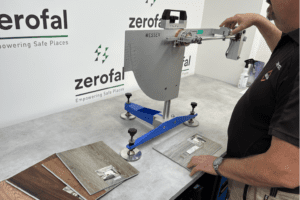
AS 4663 testing:
- Uses calibrated pendulum equipment
- Applies slope correction where required
- Requires multiple swings per run
- Calculates mean BPN for classification
Visual checks do not provide defensible data.
Zerofal’s Entry Testing Approach
Zerofal conducts retail entry testing in accordance with:
- AS 4663:2013
- ISO/IEC 17025 accredited testing through NATA
- Wet Pendulum method
- Dry Floor Friction method where applicable
- Slope correction where required
Testing is performed using calibrated equipment with traceable procedures consistent with accredited laboratory practice.
Reports are:
- Traceable
- Photographically documented
- Suitable for insurer and audit review
Entry zones are predictable risk points.
Measurement turns predictability into control.